Ang Lee’s Lust, Caution is a film that should be introduced with seriousness rather than simple sensationalism. Released in 2007, it is an adult espionage drama starring Tony Leung Chiu-wai, Tang Wei, Joan Chen, and Wang Leehom, directed by Ang Lee and based on a short story by Eileen Chang. Focus Features describes it as an erotic espionage thriller about “the fate of an ordinary woman’s heart,” centered on Tang Wei opposite Tony Leung.
At the surface level, the film tells the story of Wong Chia Chi, a young student who becomes involved in a resistance plot during Japanese-occupied China. She is asked to perform an identity, enter the social circle of Mr. Yee, and help create the conditions for his assassination. But Lust, Caution is not only about espionage. It is about acting, emotional danger, political sacrifice, and the terrifying moment when a role begins to change the person performing it.

The film begins with performance before it becomes espionage. Wong Chia Chi first enters politics through student theater, patriotic emotion, and collective idealism. This is important because Ang Lee does not present resistance as something that begins fully formed. It begins with young people performing courage, rehearsing patriotism, and believing that art can become action. The student group’s plan grows out of theatrical imagination: if they can play roles on stage, perhaps they can play roles in real life.
That idea gives the film its tragic structure. Wong Chia Chi is chosen because she can act. She can transform herself, watch others, imitate social codes, and enter a room as someone else. But espionage is not theater. In theater, the performance ends when the curtain falls. In espionage, the role enters the body, the nerves, the memory, and the conscience. The film’s deepest question is not whether Wong can deceive Mr. Yee. It is whether she can survive becoming the person required by the deception.
The BFI summarizes the plot as the story of an idealistic student who joins a plan to entice and assassinate a secret service figure, only to struggle with the emotional demands of the mission as the plan is delayed. That delay is crucial. A quick plot would remain a thriller. A delayed plot becomes psychological tragedy. Every postponed action gives feeling more time to grow. Every meeting creates more ambiguity. Every performance becomes less separable from truth.
Tony Leung’s Mr. Yee is one of the film’s most controlled and unsettling figures. He is not played as a loud villain. He is quiet, guarded, precise, and watchful. Film at Lincoln Center describes Leung’s performance as “minimalist menace,” where every glance becomes a test or a threat. This is exactly why the character is frightening. His danger does not need theatrical display. It exists in stillness, suspicion, and the sense that every room has already been measured by him.
Wong Chia Chi, by contrast, begins as someone still forming herself. She is intelligent but inexperienced, brave but unprepared, capable of performance but not yet aware of the cost of performance. Tang Wei’s performance is powerful because she allows Wong to change gradually. She does not become a professional spy overnight. She learns how to sit, how to wait, how to speak indirectly, how to conceal fear, and how to live inside a false identity that is constantly at risk of becoming emotionally real.
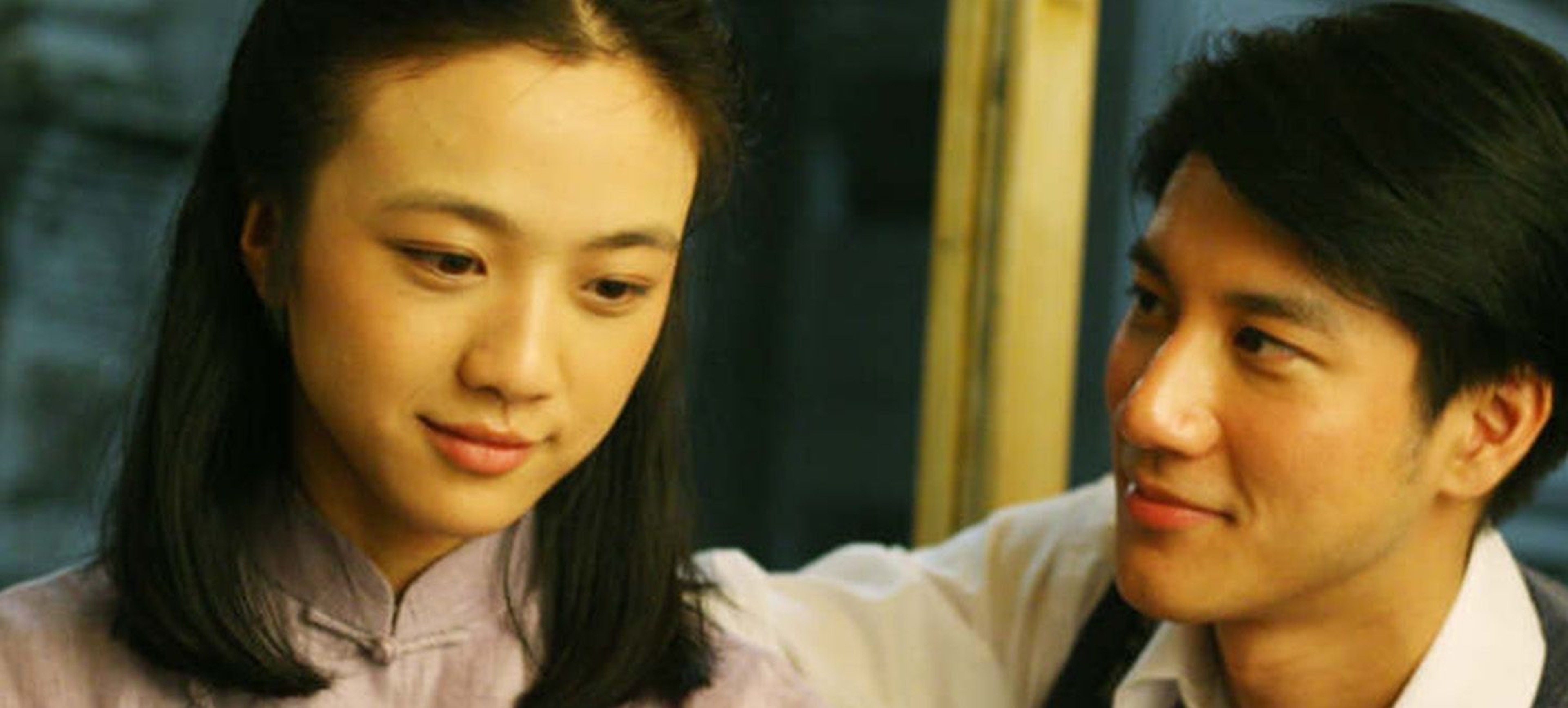
One of the film’s most intelligent choices is its emphasis on ordinary social rituals. Mahjong games, clothing, tea-room conversation, shopping trips, jewelry appointments, and polite visits become instruments of suspense. Ang Lee understands that espionage does not always look like guns, chases, or secret documents. Sometimes espionage looks like waiting politely at a table while every sentence carries hidden meaning.
The mahjong scenes are especially important. They may appear slow to viewers expecting conventional suspense, but they are central to the film’s method. Around the table, women gossip, compete, observe, and perform status. Wong Chia Chi must enter this world not as a revolutionary but as “Mrs. Mak,” a refined married woman who belongs among wealth, leisure, and coded conversation. Her success depends not only on attracting Mr. Yee, but on being accepted by the social atmosphere around him.
This makes Lust, Caution a film about gendered performance. Wong’s mission depends on being seen in a particular way: elegant, desirable, mature, harmless, and socially believable. She becomes a weapon, but the weapon is not simply beauty. It is credibility. She must persuade others that she has a husband, a class position, a history, a temperament, and an emotional availability that are all invented. The tragedy is that these inventions slowly become part of her lived experience.
Ang Lee’s direction is patient and formal. He does not rush the plot because he is interested in pressure. The film’s rhythm is one of slow tightening. The danger grows through repetition: another meeting, another glance, another delay, another chance not taken. Roger Ebert described the film as “first languid, then passionate,” noting that its slow build creates a hothouse atmosphere in the middle of war. That atmosphere is essential. The film is not suspenseful because events happen quickly. It is suspenseful because feelings become harder to control.
The physical relationship between Wong and Yee is the film’s most controversial element, and it should be discussed with careful language. The film contains explicit adult material, but its serious function is psychological and political rather than decorative. The relationship is not presented as simple romance, nor as simple manipulation. It is a dangerous zone where domination, fear, curiosity, dependency, and recognition become entangled. The BFI notes that the film’s explicit scenes caused controversy in several countries, while also arguing that they are integral to the central relationship rather than incidental display.
A constructive reading should avoid reducing Wong to either victim or betrayer. She is placed inside a mission designed by others, asked to use her body, identity, and emotional life for a political goal. Yet she is not empty. She observes, decides, hesitates, and changes. Her tragedy lies in the fact that all available choices have been contaminated. Loyalty requires self-erasure. Desire risks treason. Survival demands performance. Truth arrives too late to be innocent.
Mr. Yee is also not a figure the film asks us to excuse. He is connected to collaborationist power, interrogation, surveillance, and political violence. Film at Lincoln Center identifies him as a high-ranking collaborator responsible for torture and executions. The film’s complexity does not redeem him; rather, it makes his power more frightening. He is capable of tenderness and brutality, loneliness and calculation, vulnerability and violence. Ang Lee’s point is not that cruelty disappears when someone shows human feeling. The point is that human feeling can exist inside cruelty, making moral judgment more painful but no less necessary.
The film’s historical setting deepens this moral difficulty. Japanese-occupied Hong Kong and Shanghai are not merely backgrounds. They are worlds of occupation, collaboration, compromised survival, black-market privilege, secret police power, and resistance networks. People speak carefully because words can be dangerous. Rooms are full of listening. Public behavior is coded. Private emotion is never fully private because history has entered every relationship.
This is why Lust, Caution should not be discussed only as an erotic drama. It is an espionage tragedy about how political violence uses private life. Wong Chia Chi’s body becomes a battlefield not in a simple symbolic sense, but in a practical one: her personal boundaries, identity, and future are all turned into tools by the resistance plan. The film asks whether patriotic sacrifice can become another kind of exploitation when the person sacrificed is treated as a means rather than a full human being.
Kuang Yumin, played by Wang Leehom, is important because he represents youthful idealism mixed with emotional limitation. He believes in the cause, but his belief does not fully protect Wong. Like many young revolutionaries in cinema, he is brave but naïve, passionate but incomplete. He helps set events in motion without understanding the full cost to the person asked to carry the most intimate burden.
Old Wu and the professional resistance network add another layer. Once the amateur student plot becomes connected to organized resistance, the language becomes colder. Strategy replaces youthful feeling. Wong’s suffering becomes a tactical problem. Delay becomes acceptable because the operation requires the right moment. This is politically understandable but emotionally devastating. The film’s power lies in showing that noble causes can still require morally brutal instruments.
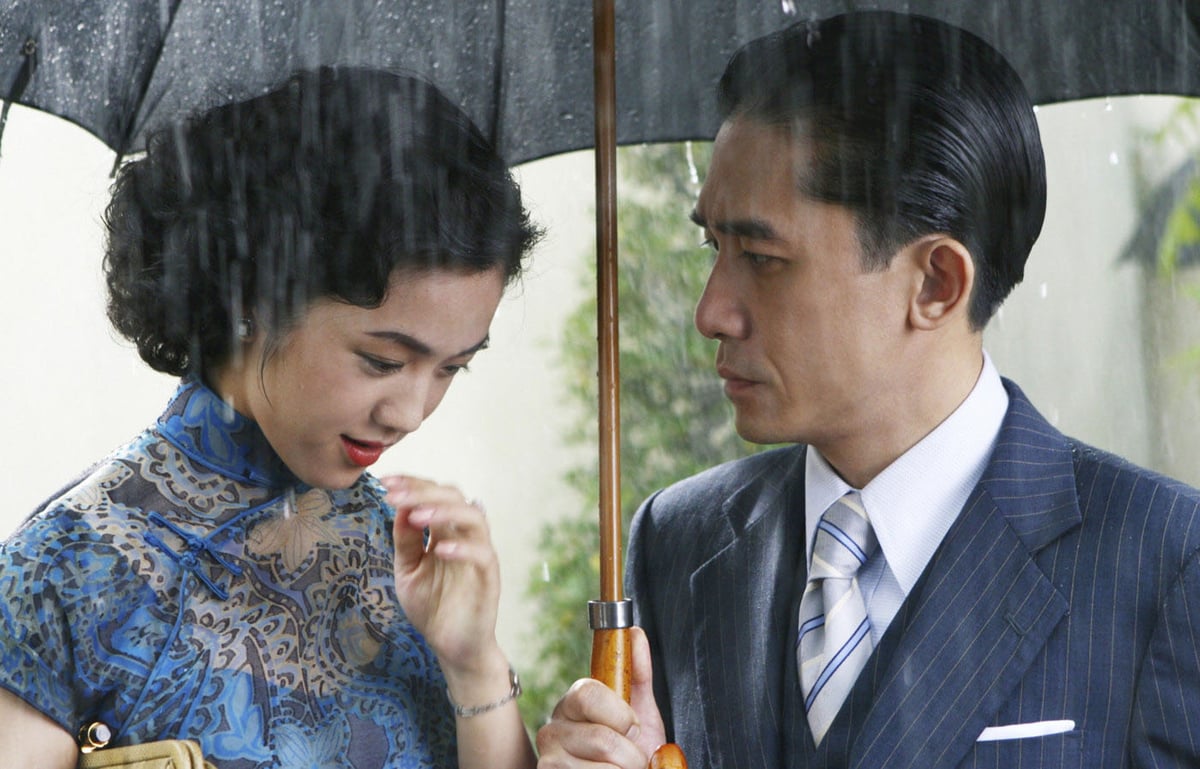
Visually, Lust, Caution is one of Ang Lee’s most carefully designed films. The costumes, interiors, streets, cars, restaurants, and rooms are not merely period decoration. They create an environment where beauty and danger coexist. A qipao is not only clothing; it is social disguise, gender code, class performance, and emotional armor. A ring is not only jewelry; it is proof, bait, confession, and fatal object. A closed room is not only a private space; it is a zone where history becomes intimate.
The film’s Chinese title, Se, Jie — 色,戒 — carries layered meanings. Commonly translated as Lust, Caution, the title also suggests color and ring through alternate readings, connecting desire, warning, and the diamond ring that becomes crucial late in the story. This title is unusually precise. It does not merely name a feeling; it names a conflict. Desire attracts, caution warns, and the ring binds both together.
The jewelry-store sequence near the end is one of the great moments of modern espionage cinema because it transforms a small gesture into moral catastrophe. The plot has been built for this moment. The resistance is ready. The trap is nearly complete. And yet the entire machinery of politics, strategy, sacrifice, and revenge is interrupted by a human impulse that cannot be cleanly explained. Wong’s choice is not simple love, not simple betrayal, and not simple weakness. It is the moment when the role collapses and the person inside it acts.
That is what makes the ending devastating. In many spy films, the final question is whether the mission succeeds. In Lust, Caution, the question becomes more severe: what remains of a person after the mission has consumed her? Wong is used by history, by men, by politics, and by her own capacity to feel. Her final decision does not save her. It only reveals that she was never simply a tool.
Ang Lee won the Golden Lion at the Venice Film Festival for Lust, Caution, and Film at Lincoln Center also identifies the film as a Golden Lion winner. The award matters because the film is not merely controversial; it is formally ambitious. Its length, slowness, emotional complexity, and refusal to offer clean moral categories all belong to serious art cinema. It asks viewers to sit with discomfort rather than consume suspense as entertainment.
At the same time, the film remains debated. Some viewers find it too long, too controlled, or too dependent on difficult adult material. Others see its severity as essential to its meaning. Ebert argued that the film’s intimate scenes are treated for psychological meaning rather than simple erotic effect, while also noting that the film may feel overextended to some viewers. That divided response is understandable. Lust, Caution demands patience and emotional tolerance. It is not designed for casual viewing.
Compared with The Piano Teacher, Lust, Caution is warmer in visual texture but equally concerned with control and damage. Compared with Eyes Wide Shut, it is less dreamlike and more historically grounded, yet both films explore the relationship between desire, secrecy, and power. Compared with The Night Porter, it is less openly about postwar trauma but similarly concerned with the dangerous bond between intimacy and political violence. Compared with Belle de Jour, it turns performance and hidden identity into matters of life and death.
For forum discussion, the strongest approach is to frame Lust, Caution as a film about performance under historical pressure. Wong Chia Chi performs as an actress, as a patriot, as Mrs. Mak, as a lover, as a tool of resistance, and finally as someone who can no longer fully separate those roles. Mr. Yee performs as official, husband, suspecting predator, controlled gentleman, and lonely man. Around them, everyone performs survival.
The film’s tragedy is that performance does not remain external. If one performs courage long enough, fear changes shape. If one performs intimacy long enough, feeling may become real. If one performs betrayal long enough, loyalty may become impossible to define. Ang Lee’s film understands that identity is not fixed beneath the mask. Sometimes the mask alters the face.
As a recommendation, Lust, Caution is best suited to mature viewers interested in historical drama, espionage, Chinese literature, Ang Lee’s cinema, Tony Leung’s acting style, Tang Wei’s breakthrough performance, and films where politics and private emotion become inseparable. It is not suitable for viewers seeking fast-paced spy action, light romance, or simple moral certainty. Its power lies in slowness, ambiguity, and emotional risk.
Ultimately, Lust, Caution is a film about the cost of turning a human being into a mission. It shows how political history enters the body, how performance becomes identity, how desire can become both weapon and wound, and how one brief act of feeling can destroy an entire structure of strategy. It is beautiful, but its beauty is never innocent. It is suspenseful, but its suspense is emotional rather than mechanical. It is intimate, but the intimacy is haunted by occupation, betrayal, and death.
That is why the film remains so memorable. Lust, Caution does not ask whether Wong Chia Chi made the “right” decision. It asks whether any clean decision was still possible by the time she had to choose. Ang Lee leaves the viewer with a painful paradox: the moment that looks most like betrayal may also be the moment when the character finally acts from the truth of her own altered heart.